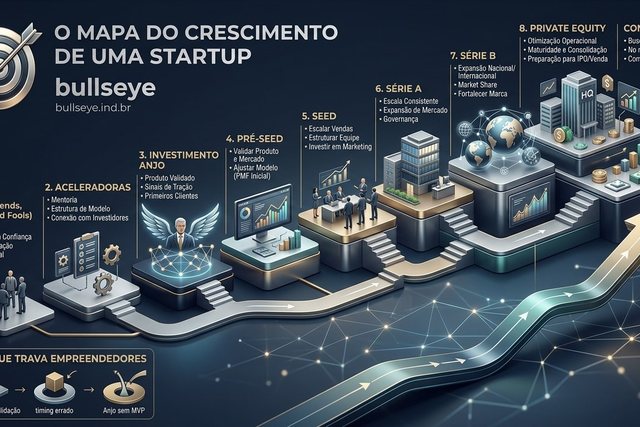
What angel investment is, how it works, what angel investors assess before investing and why “smart money” is worth more than the capital itself.
When entrepreneurs look for investment, they usually think only about capital. But in the world of high-growth businesses, money is just one part of the equation. Angel investment is one of the most effective models for boosting early-stage or expanding companies, because it comes with hands-on experience, strategic vision and access to a network of contacts.
Understanding how it works and what angel investors look for greatly increases your chances of closing with the right person.
What angel investment is
Angel investment is funding provided by an individual, usually an experienced business owner or executive, to a new or growing company. In return, the investor receives an equity stake or an instrument that can be converted into equity in the future, such as a convertible note.
In Brazil, Complementary Law 155/2016 (Lei Complementar 155/2016) gave this model more legal certainty: angel investors can invest without becoming partners, without being liable for the company’s debts and without taking part in management, with returns and terms defined by contract. Amounts are usually smaller than those of venture capital funds, and several angels often invest together through groups or associations.
Why angel investment accelerates growth
Companies that receive angel investment evolve faster because they stop learning only from their own mistakes and start learning from the experience of people who have already walked the path. The most visible effects are:
- Fewer strategic mistakes on costly decisions.
- Faster decision-making and execution.
- Access to customers, suppliers and future investors.
- More credibility in the market and in later rounds.
What angel investors assess before investing
Angel investors take on high risk, so they look very carefully at a few points:
- People: before the business comes the entrepreneur, with their ability to execute, resilience and vision.
- Scalability: the potential to grow without costs rising at the same pace.
- Market: large or expanding markets.
- Competitive edge: what makes the company hard to copy.
- Return potential: high risk requires the prospect of a high return.
Those who arrive prepared, with organized numbers and a clear plan, stand out. See the investor checklist and the guide on how to prepare your project for investors.
Smart money versus ordinary money
So-called smart money comes with mentoring, strategic connections, support in structuring the business and access to new investors. It is this combination that multiplies the chances of success. Two investments of the same amount can have very different impacts depending on who is behind them.
That is why choosing the investor is as important as being chosen. Ask yourself: does this person know my industry? Do they have time to follow the business? Do they open doors I could not open alone? Aligning expectations prevents conflicts down the road.
Angel investment and the next rounds
The angel is often the first outside capital in the business. A good start makes the following investment rounds easier: the company arrives better organized, with results to show and with an investor who helps present the opportunity to funds and other partners.
In practice, angels are found in investor groups and associations, innovation events, accelerators and, very often, through referrals. An introduction made by someone trusted opens more doors than dozens of messages sent without context. That is why the entrepreneur’s network matters as much as the project.
Conclusion
Angel investment is one of the most powerful tools for growing quickly and in a structured way, but it requires preparation, strategy and clarity. It is not just about raising funds; it is about choosing who will be by your side for the coming years.
Frequently asked questions
Does an angel investor become a partner in the company?
Not necessarily. Under Brazil’s Complementary Law 155/2016, an angel investor can invest without becoming a partner and without being liable for the company’s debts. Convertible notes, which may turn into equity in the future, are also common.
How much does an angel investor usually invest?
Amounts vary widely but are generally smaller than those of venture capital funds. Several angels often invest together through groups or associations to combine capital and experience.
What is the difference between angel investment and venture capital?
An angel is an individual investing their own money, usually at the company’s early stage. Venture capital is a fund that invests third-party money, in larger amounts and typically at later stages.
What should I prepare before approaching an angel investor?
A clear plan, organized numbers, a realistic view of the company’s value and an objective explanation of how the investment will be used. Showing the team and what has already been achieved carries a lot of weight.
Looking for the right investor for your business? Bullseye connects entrepreneurs with investors aligned with their stage. Get in touch.